
Introduction to Ezekiel
__largepreview__.webp)
Introduction to Ezekiel
Key Themes
The prophet Ezekiel authored the seventh book of the Nevi’im ("The Prophets"). His name, Ezekiel (Hebrew: Yekhezqe’l), is derived from the Hebrew words chazaq ("to strengthen" or "to be strong") and 'el ("God"), meaning "God strengthens" or "God will strengthen".
According to Dr. Arnold Fruchtenbaum, the overarching theme of the book is the departure and eventual return of the Shechinah glory. This glory, which is the visible manifestation of God's presence, originally dwelt in the Holy of Holies of the Tabernacle and later in Solomon's Temple, rendering the structure indestructible as long as it remained. Ezekiel documents the tragic departure of the Shechinah due to Judah's sin, but the book concludes with a message of hope, detailing its return to the Holy of Holies of the Millennial Temple during the Messianic Kingdom in chapters 40–48.
In recording his prophecies, Ezekiel pursued two primary objectives: to remind his fellow Jewish exiles of the specific sins that led to their captivity, and to strengthen Israel's hope by emphasizing the promise of a future national restoration.
Commentary Insights
Ezekiel was a Levitical priest and the son of Buzi, likely affiliated with a specific priestly faction known as the sons of Zadok, a group destined to play a significant role in the millennial future. His expected life path of preparing sacrifices and instructing the Israelites was abruptly interrupted when he was taken captive to Babylon during the second deportation in 597 B.C., alongside King Jehoiachin and 10,000 skilled craftsmen. In exile, he settled by the river Chebar, a royal Babylonian canal connected to the Euphrates River, near an unidentified hill city called Tel-abib.
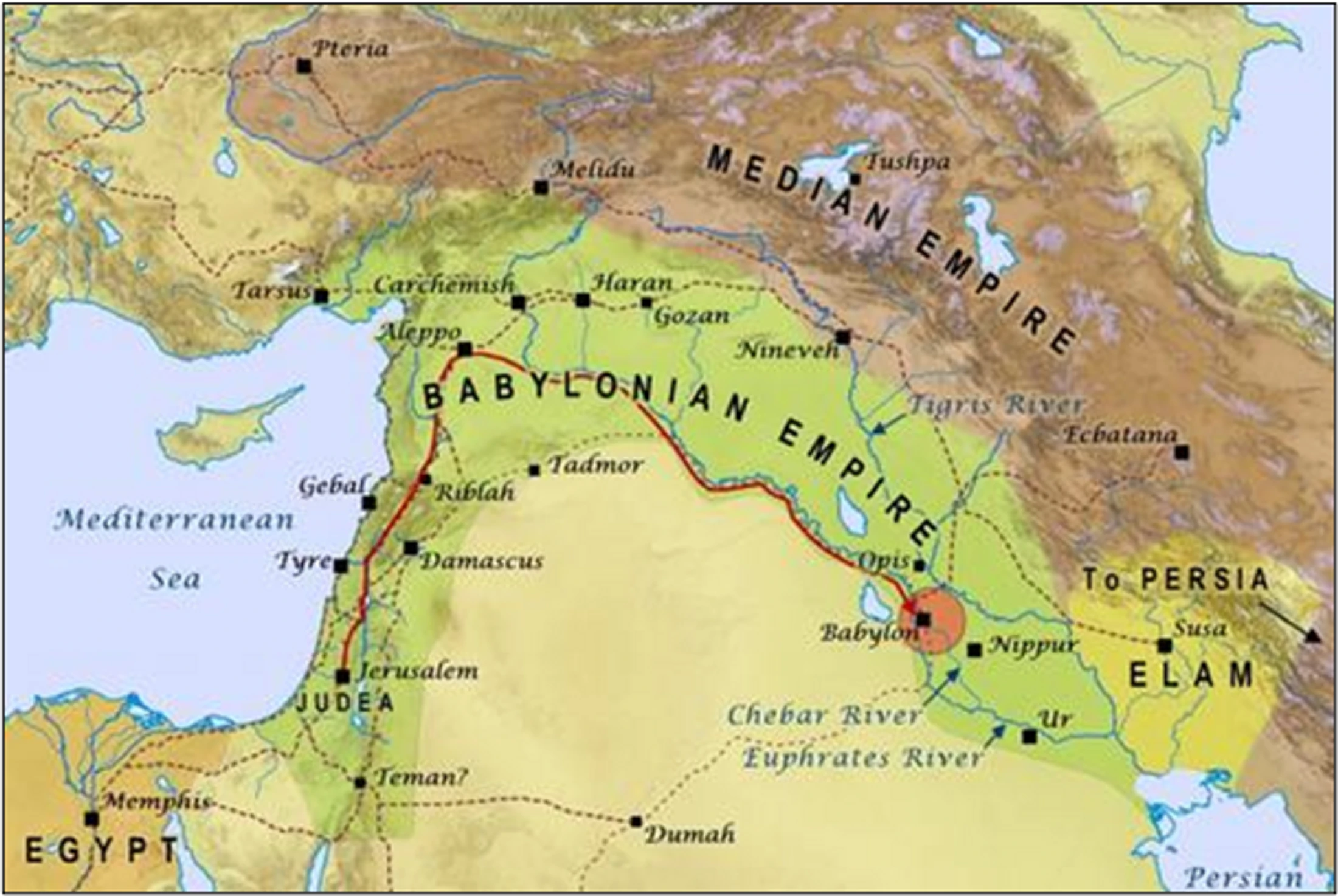
Map showing the approximate location of the Chebar River in the region of Nippur within the Babylonian Empire, where Nebuchadnezzar settled the Jewish exiles.
Ezekiel was born in Judah around 623 B.C. and was called to his prophetic office in 593 B.C. at the age of thirty—the exact year he would have normally qualified for induction into the priesthood. His prophetic ministry spanned twenty-two years, concluding around 571 B.C.
Historically, Ezekiel lived during the reigns of the last five kings of Judah: Josiah, Jehoahaz, Jehoiakim, Jehoiachin, and Zedekiah. Notably, Ezekiel never addressed Zedekiah as king, only as "prince," because from a Jewish perspective, the imprisoned Jehoiachin was still the rightful monarch. Ezekiel's ministry overlapped with two other major prophets: Jeremiah, who ministered primarily in Judah, and Daniel, who had already gained an important reputation in the Babylonian royal court.
Stylistically, Ezekiel conveyed God's messages through dramatic visions and symbolic actions. He frequently used the Hebrew expression ben adam ("the son of man") to emphasize human frailty, and repeated the formula "you/they shall know that I am YHWH" more than 60 times to highlight God's sovereignty in both judgment and national restoration.
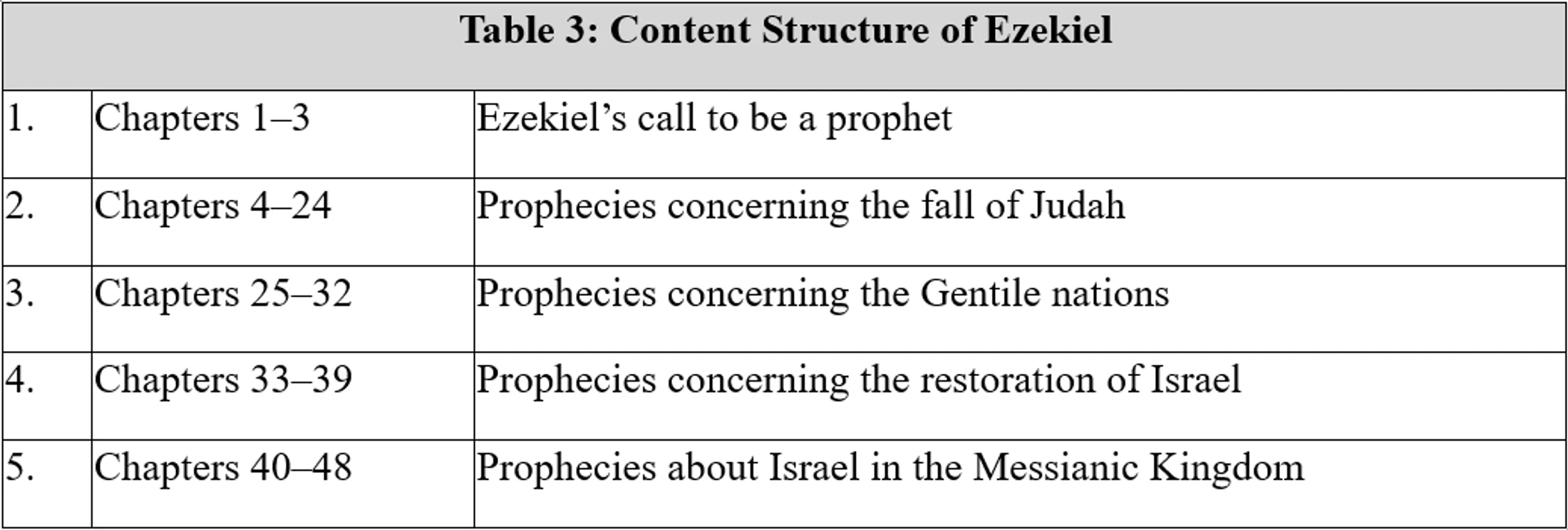
Summary of the Content Structure of Ezekiel.
Summary of the Historical Structure of Ezekiel.
Theological Significance
Ezekiel makes critical contributions to eleven of the thirteen categories of Systematic Theology, notably excluding ecclesiology (the church is completely unmentioned) and demonology.
The book extensively develops Israelology (the Doctrine of Israel). It reinforces God's unconditional covenantal relationship with the nation, proving that national election guarantees Israel's physical survival and future national spiritual salvation. Ezekiel highlights Israel's specific sin of idolatry—viewed strictly as spiritual adultery—and details their Messianic hope under the New Covenant.
In Eschatology (the Doctrine of the Last Days), Ezekiel confirms Israel's future national regeneration, where the people will receive a new heart and the indwelling of the Holy Spirit to keep God's righteous standards. He outlines a global regathering, the reunification of the divided kingdoms, the reestablishment of the Davidic throne under the resurrected David as prince, and the intricate architectural details of the Millennial Temple.
Ezekiel also provides profound insights into Satanology (the Doctrine of Satan). It records the origin and fall of Satan, detailing the first two of his six chronological abodes. Satan's initial abode was upon the "holy mountain of God," serving as the "anointed cherub that covers," acting as a canopy overshadowing God's throne. His second abode was in Eden, the mineral garden of God on the original earth, prior to his fall.
Finally, in Pneumatology (the Doctrine of the Holy Spirit), the book connects the Spirit directly with the visible Shechinah glory, the regeneration of the Jewish people, and the future indwelling ministry promised to Israel in the New Covenant.
The content presented here is a condensed recap derived from Dr. Arnold G. Fruchtenbaum’s work, Ariel’s Bible Commentary: The Book of Ezekiel.