
The Parable of the Vine and The Unfaithful Wife
__largepreview__.webp)
The Parable of the Vine and The Unfaithful Wife
Ezekiel 15:1-16:63
Key Themes
Ezekiel 15 and 16 continue to dismantle any false hope that Judah will escape impending judgment. Chapter 15 utilizes a parable to demonstrate Jerusalem's uselessness apart from divine discipline. Chapter 16 expands on this through a profound and graphic allegory detailing God's relationship with Israel. The overarching theme is Israel’s transformation from a helpless, abandoned infant into a royal bride, and finally, into an impudent, unfaithful wife. Because of her spiritual adultery, YHWH must execute the severe curses of the Mosaic Covenant, but the text ultimately guarantees a future eschatological restoration through an everlasting marriage contract.
Verse-by-Verse Insights
The Parable of the Vine (15:1-8)
The parable centers on the ets haggefen, a wild wood vine that is stunted and fails to produce fruit. Because it is useless for bearing fruit, Ezekiel asks if its wood can even be used to craft a yathed, a wooden peg used to hang vessels in a tent. The answer is no; it is only fit for fuel. The parable notes that the fire has already devoured both ends of the vine—symbolizing the earlier Assyrian destruction of the Northern Kingdom and the first Judean deportations—leaving the middle ready to burn. In the application, YHWH uses the Hebrew term laken—functioning here as an assured "conversation director"—to declare that the inhabitants of Jerusalem will likewise be given to the fire because they committed a trespass against His law.
Jerusalem the Abandoned Child and The Marriage (16:1-14)
Chapter 16 transitions from a parable to an allegory, distinguished by its narrative structure and multifaceted points. YHWH depicts Jerusalem’s origins in Canaan, describing her as an unwanted baby girl cast into an open field. At her birth, she was left unwashed and not "salted at all"—a Middle Eastern practice of scrubbing a newborn with salt to cleanse and firm the skin. God passed by and sovereignly commanded the dying infant to "live!"
Later, during the Exodus, YHWH passed by again and saw that her time was the "time of love" (dod), a term specifically referring to romantic, marital love. God spread His skirt over her, symbolizing espousal, and entered into the Mosaic Covenant, making Israel His wife. He washed her, clothed her in broidered work and fine linen, and adorned her with royal jewelry. During the reigns of David and Solomon, Israel's beauty became perfect among the nations solely because of God's majesty.
The Great Adultery (16:15-34)
Tragically, Israel trusted in her own beauty and played the harlot. The nature of this adultery was idolatry; she used God's gifts of garments and jewels to construct bamot teluot ("multicolored high places") and fashioned images of men (teraphim) for worship. The degree of her degradation culminated in the ultimate idolatrous crime: sacrificing her own children by causing them to pass through the fire.
Israel's adultery also encompassed political alliances with Egypt, Assyria, and Chaldea. To provoke God, she lusted after the Egyptians, who were "great of flesh". The Hebrew term basar (flesh) here euphemistically refers to male genitals, emphasizing Egypt's excessive sensuality and Israel's insatiable lust for worldly power. In a shocking reversal of typical prostitution, Israel scorned hire; instead of being paid, she used the gifts God gave her to bribe her pagan lovers.
The Punishment and Comparison to Sodom (16:35-52)
Because of this spiritual adultery, YHWH sentences Israel to the legal punishments for women who break wedlock and shed blood: stoning and burning. God promises to gather the very nations Israel lusted after to strip her naked, execute her, and burn her houses. Ezekiel then introduces a proverb: "As is the mother, so is her daughter". He compares Jerusalem to her elder sister, Samaria, and her younger sister, Sodom. Jerusalem's depravity was so profound that she made Sodom—whose sins included pride, prosperous ease, and ignoring the poor—appear righteous by comparison.
The Remarriage (16:53-63)
Despite this severe rebuke, the chapter concludes with eschatological hope. YHWH promises to remember the covenant of her youth and establish an everlasting covenant with her.
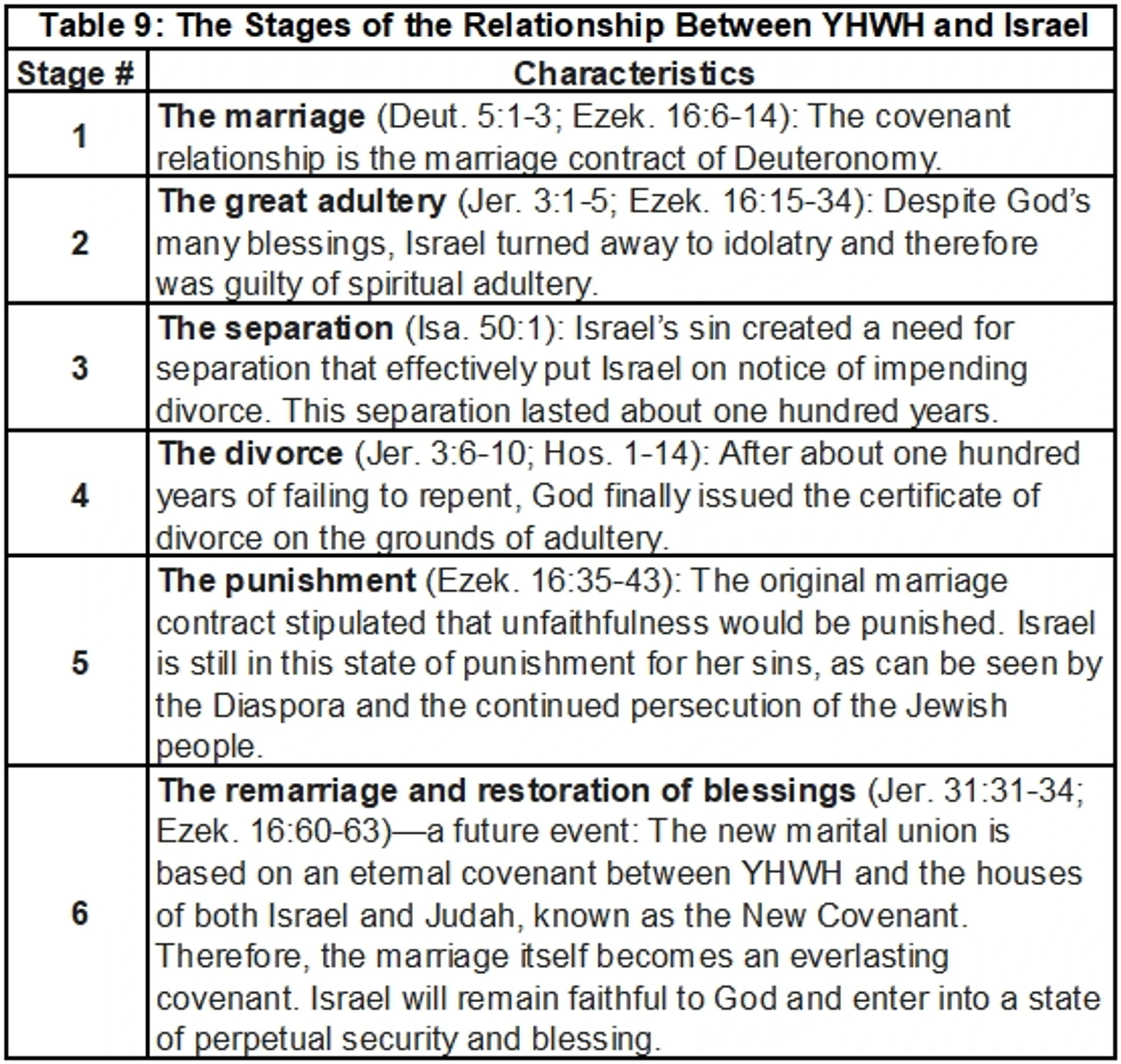
Table 9: The Stages of the Relationship Between YHWH and Israel, detailing the six stages from the original marriage contract (Deut. 5), the great adultery, separation, divorce, punishment (Diaspora), and the future remarriage based on the New Covenant.
Israel will remember her unfaithfulness and be utterly confounded by shame when God finally forgives her.
Theological Significance
Ezekiel 15 and 16 forcefully articulate the mechanics of Israelology and the nature of God's covenantal discipline. Israel's national election guarantees her survival, but it does not exempt her from the penalties of the Mosaic Law. Idolatry is consistently defined as spiritual adultery, a direct violation of the marriage contract established at Sinai. Because Israel refused to repent over centuries of separation, God was forced to issue a bill of divorce and initiate the long period of punishment known as the Diaspora.
Furthermore, this text is so explicit in its denunciation of Israel's apostasy that Rabbinic Judaism historically restricted its public reading. Yet, theologically, the chapter is essential for establishing the necessity of the New Covenant (Jeremiah 31:31-34). The Messianic Kingdom requires a new, eternal marriage contract, ensuring that when regenerate Israel is permanently restored to her Husband, she will never again stray into spiritual adultery.
The content presented here is a condensed recap derived from Dr. Arnold G. Fruchtenbaum’s work, Ariel’s Bible Commentary: The Book of Ezekiel.