
Prophecies of Judgement, The Prophet's Muteness, and The Symbolic Actions
__largepreview__.webp)
Prophecies of Judgement, The Prophet's Muteness, and The Symbolic Actions
Ezekiel 3:22-5:17
Key Themes
Ezekiel 3:22–5:17 marks the practical commencement of Ezekiel’s prophetic ministry, shifting from his initial calling to the vivid delivery of God's message concerning the impending fall of Judah. A central theme of this section is Ezekiel’s personal submission to God's severe instructions, including physical confinement, muteness, and the performance of dramatic, uncomfortable symbolic actions. Because the Jewish exiles were a rebellious house incapable of grasping spiritual truths, God required Ezekiel to act out His messages visually, transforming the prophet's own life into a living sign of the inevitable judgment destined for Jerusalem.
Verse-by-Verse Insights
The Prophet’s Muteness (3:22-27)
God commanded Ezekiel to go out into the plain (bikah, which may denote a valley), where he experienced his second vision of the Shechinah glory. The Holy Spirit entered Ezekiel, setting him on his feet, and delivered three strict instructions for his ministry. First, he was to shut himself inside his house, refraining from public ministry. Second, God Himself would bind Ezekiel with ropes, restricting his physical movement. Third, God imposed a ritualistic muteness upon the prophet, making his tongue cleave to the roof of his mouth. God explained that this was to prevent Ezekiel from being a reprover in his own natural tendency. Ezekiel could speak only when YHWH specifically opened his mouth to deliver divine revelation. This selective muteness endured for seven-and-a-half years, lifting only when a refugee arrived to confirm Jerusalem's destruction.
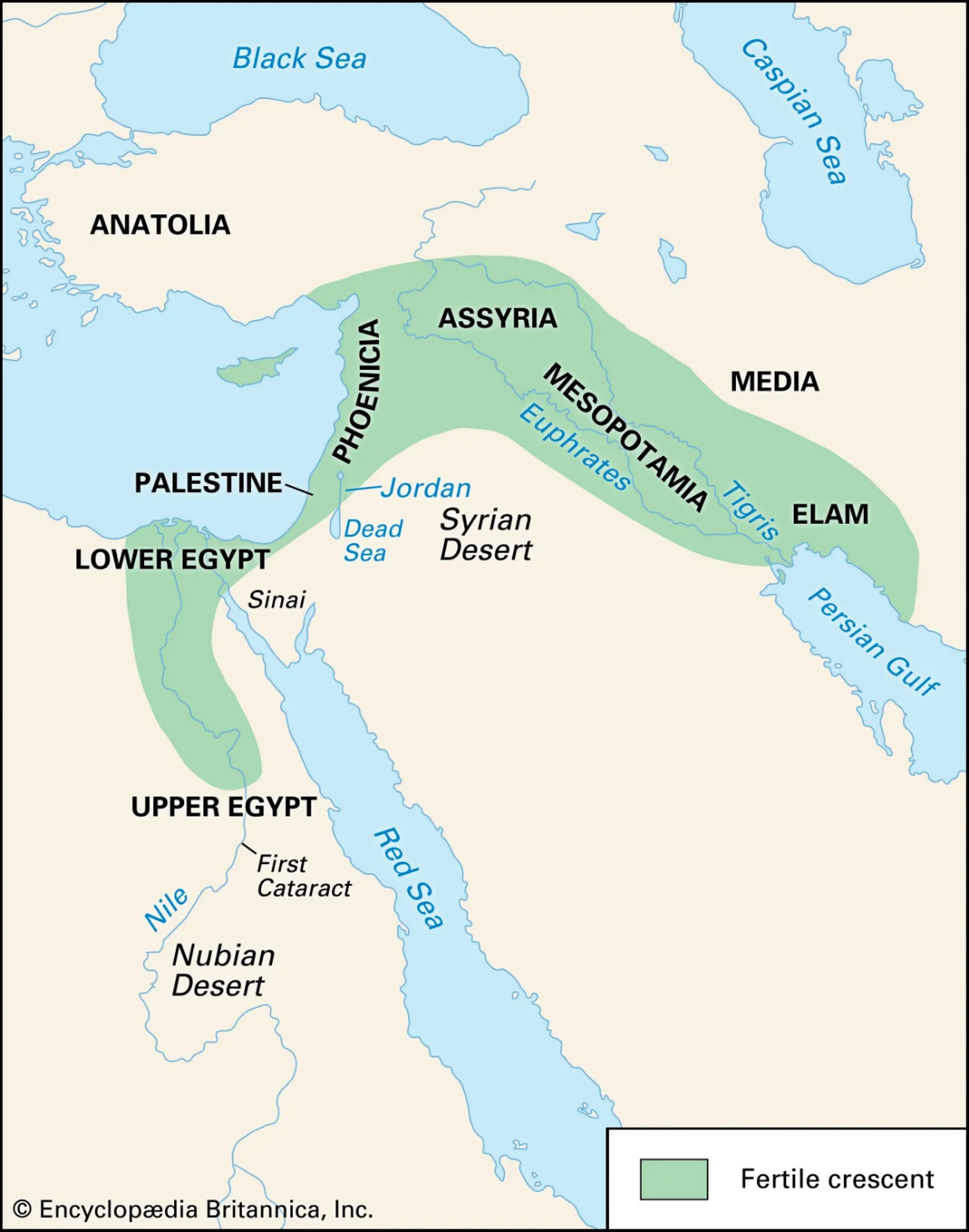
General map of the Mesopotamian Basin and the extent of the Fertile Crescent, providing visual context for the geographical region where Ezekiel was confined in exile.
The Symbolic Actions (4:1–5:4)
Confined to his home, Ezekiel used four sign-acts to engage the people's senses:
The Sign of the Tile (4:1-3): Ezekiel drew an outline of Jerusalem on a soft clay tablet (levenah) and built miniature siege works around it. He then placed a flat iron pan (machavat) between himself and the city, representing a partition wall, and set his face against the model to symbolize God's irrevocable decree to besiege Jerusalem.
The Sign of the Posture (4:4-8): Ezekiel was commanded to lie on his left side for 390 days to bear the iniquity of the Northern Kingdom, and then on his right side for 40 days for Judah. God supernaturally bound him in these positions. This total of 430 days represented 430 years. Fruchtenbaum notes that this 430-year span prophetically foretells the duration of complete Gentile domination over the Jews following the fall of Jerusalem, taking a forward-looking approach rather than mapping it to the past.
The Sign of Defiled Bread (4:9-17): Ezekiel baked bread from a mixture of grains and legumes. He was initially told to bake it using human dung for fuel, which prompted a protest from the priest, leading God to permit the use of cow dung instead. This act signified that God would break the staff of bread in Jerusalem, leading to a famine so severe that the people would eat and drink by strict weight and measure in absolute dismay.
The Sign of the Shaved Head (5:1-4): Using a sharp sword—symbolizing the sword of Nebuchadnezzar—Ezekiel shaved his head and beard. He divided the hair into thirds: one third burned in the midst of the model city (representing death by famine and pestilence), one third struck with the sword around the city (death in battle), and one third scattered to the wind (dispersion into exile). A few hairs were bound in his garment's skirts, promising a surviving remnant, though even some of those would face the fire of judgment.
The Interpretation (5:5-17)
God provided the application for these signs, identifying Jerusalem as the center (betoch, or navel) of the nations. Instead of being a righteous witness, Jerusalem had become more turbulent (hamanechem) and wicked than the surrounding Gentile nations. Consequently, God promised to execute a unique and merciless judgment through five methods: famine, evil beasts, pestilence, blood (disease), and the sword.
Theological Significance
This passage is highly significant for addressing common rabbinic criticisms that claim Ezekiel violated Mosaic Law. Fruchtenbaum demonstrates strict continuity between Ezekiel and the Torah. For example, Leviticus 19:19 prohibits sowing mixed grains, but does not forbid mixing them for baking, validating Ezekiel's bread recipe. Furthermore, while priests were forbidden from shaving their heads (Lev. 21:5), Ezekiel was acting strictly in his capacity as a prophet conveying divine judgment, not as an active priest in Temple service.
The passage emphasizes God's sovereign control over Israel's timeline and discipline. The 430 days of Ezekiel's posture establish a precise prophetic countdown regarding Israel's loss of national autonomy. Additionally, the text underscores the principle that God's covenantal judgments upon Israel are always executed to bring about a specific theological realization, as expressed in the recognition formula: "you shall know that I am YHWH." Through the absolute destruction of their idolatrous centers, God strategically relocated the Jews to Babylon—the birthplace of idolatry—to cure the nation of their desire for false gods.
The content presented here is a condensed recap derived from Dr. Arnold G. Fruchtenbaum’s work, Ariel’s Bible Commentary: The Book of Ezekiel.